
Trust Is the Accelerator, Not the Brake
By David Schifman, Chief Revenue Officer, Asenion
I’ve sold trust for 25 years. The products kept changing. The sale didn’t.
In 1998 I was one of four salespeople building the first channel for what became BlackBerry, out of Waterloo, Canada. Here’s the part people forget: users didn’t wait for IT to say yes.
They installed the BlackBerry Desktop Redirector. They left their PCs running and their laptops docked on their desks, and their email followed them out the door. It didn’t look like forwarded mail. It was their own inbox, and when they replied, the reply went out from their work address. Salespeople answered clients from airport lounges while their competitors were still waiting to get back to the office. Nobody in IT had signed off on any of it.
IT found out the way IT always finds out: a senior executive walked into the help desk with a BlackBerry on their belt and asked them to make it work. And the question they asked was the one we’d been preparing for: can we trust this with our email? When we could show them how the data was protected and who controlled it, they stopped trying to shut it down and started running it themselves. That’s how BlackBerry became the enterprise standard. The users created the demand. Trust turned it into a deployment.
Then came 2018. I watched a tech CEO testify before Congress about how people’s data had been handled, and I decided which side of that argument I wanted to work on: the side people could trust with their data. I went to Apple, a company that had built its position on that principle. Privacy wasn’t a policy page there. It was part of the product, and customers could see it.
It’s happening again: today’s Desktop Redirector is a browser tab
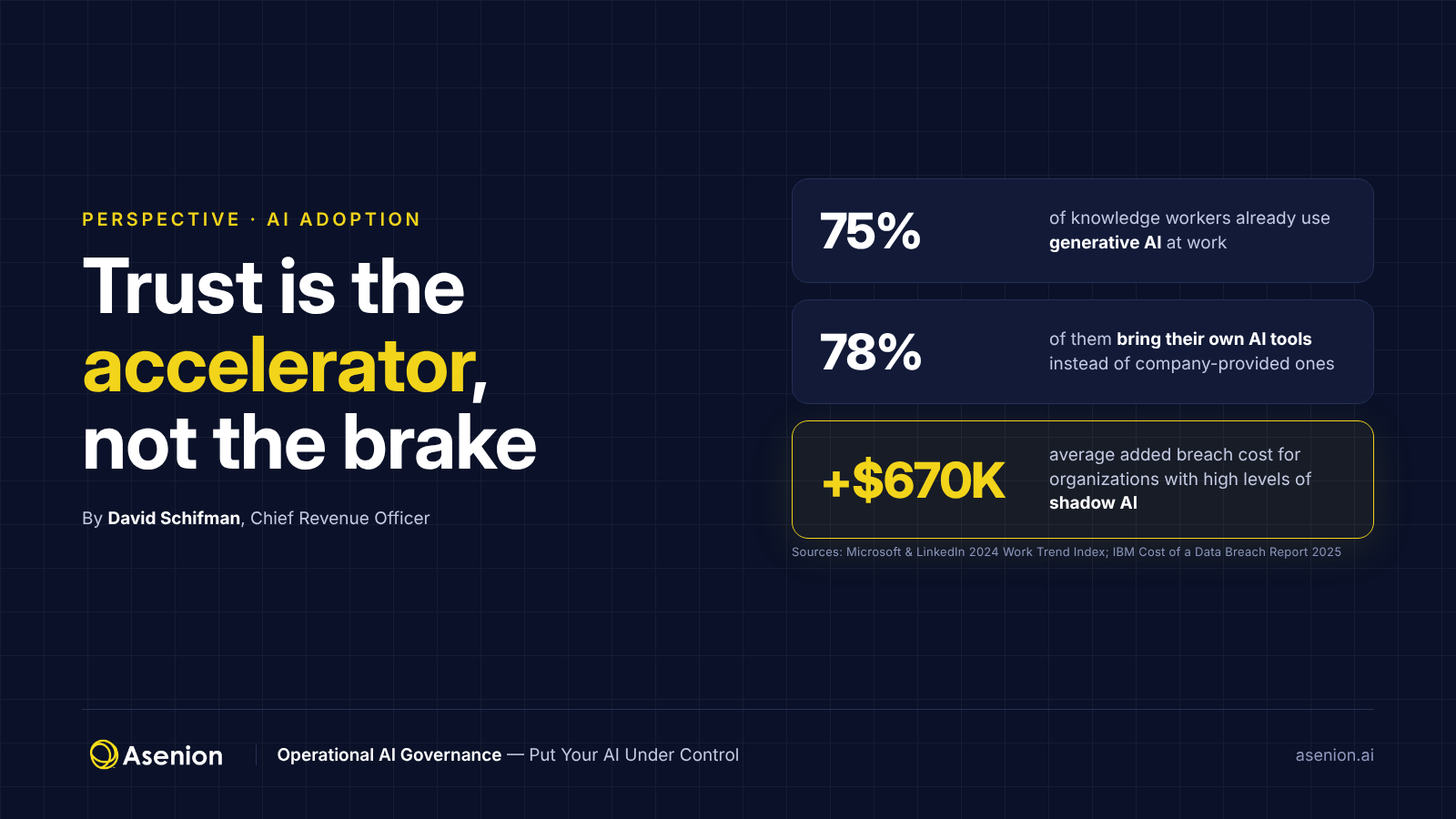
When Microsoft and LinkedIn surveyed 31,000 people in 31 countries for their 2024 Work Trend Index, 75% of knowledge workers said they were already using generative AI at work. 78% of those users were bringing their own tools rather than using ones their company provided.
People aren’t doing this to cause trouble. They’re doing it for the same reason my customers ran the redirector more than 25 years ago. It makes them faster, and they aren’t going to give that up while a policy gets written.
The difference is what’s at stake. Back then the risk was an email on a pager. Today it’s customer records, source code and contracts pasted into tools nobody has assessed. IBM’s 2025 Cost of a Data Breach report found that organizations with high levels of unapproved “shadow AI” paid an average of $670,000 more per breach, and that 63% of breached organizations had no AI governance policy or were still developing one.
Shutting it down didn’t work then, and it isn’t working now. The usage is already there. The question is whether the organization can say yes with controls it trusts.
Where trust actually breaks
I’ve built AI agents myself. Even with rules I wrote, I watched one cross a line it had been told not to cross, while all my checks showed green.
The policy was right. The documentation was right. The point-in-time review would have passed. What failed was the behaviour of the system while it was running, and nothing I had in place was watching it.
I’m not alone in that. IBM’s 2025 Cost of a Data Breach report found that 97% of organizations that had an AI-related breach lacked proper AI access controls.
That is where trust breaks for many organizations putting AI into production. Not in the policy, but in the gap between the policy and what the system does on a Tuesday afternoon.
Why trust speeds things up
The companies I’ve watched move fastest with new technology are the ones that could answer the trust question first. BlackBerry won the enterprise because security officers said yes. Apple turned privacy into a reason to buy.
AI works the same way. When a bank can show its regulator what its agents are allowed to do, and what they did, the next use case doesn’t start from zero. When a hospital can show how patient data is controlled at runtime, the clinical team stops waiting for permission.
That’s the work Asenion does. We turn the requirements you already have, from regulations and standards to your own policies, into controls that run with the AI system, and evidence of what actually happened. You can read how that works in From the Language of Compliance to the Language of Machines.
Your people have already adopted AI. The organizations that treat trust as a brake will spend next year chasing it. The ones that treat it as the accelerator will be scaling what the others are still trying to approve.


