
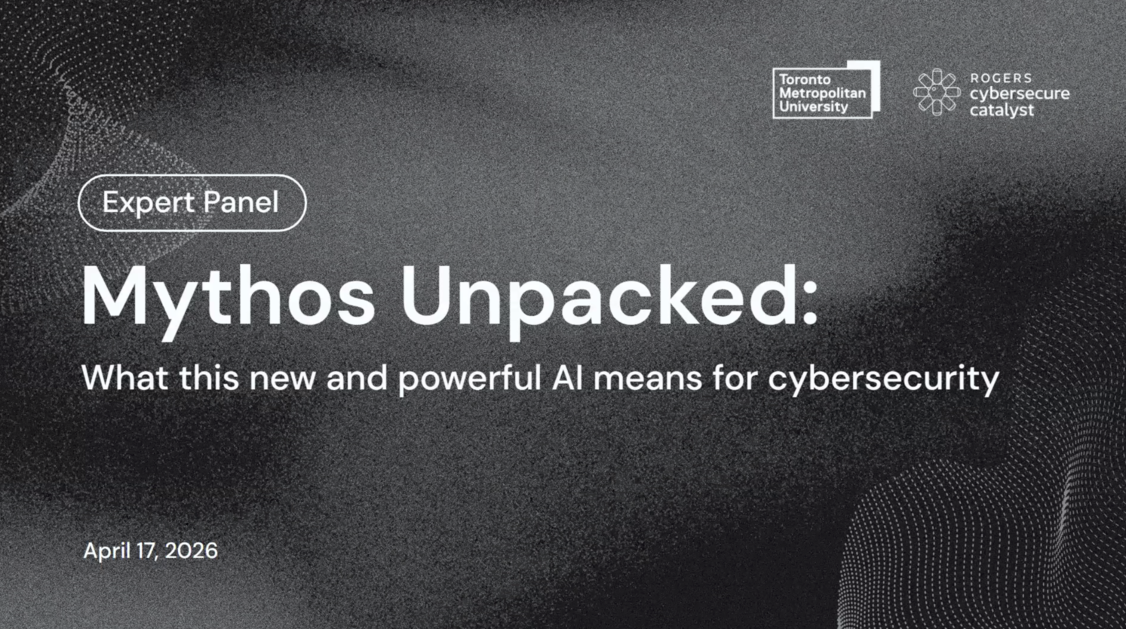
What Claude Mythos Preview Means for Cybersecurity: Key Insights from the Rogers Cybersecure Catalyst Webinar
.png)
The cybersecurity landscape may have just changed, permanently.
At a recent Rogers Cybersecure Catalyst webinar, Asenion Co-founder and CPO Fion Lee-Madan joined leaders from RBC and TrojAI to unpack a critical development:
Anthropic’s Claude Mythos Preview, an AI model capable of discovering and exploiting zero-day vulnerabilities across major systems at unprecedented speed.
While not publicly released, Mythos signals a major shift in how cyber risk will evolve in the age of AI.
What Is Claude Mythos Preview (and Why It Matters)?
Claude Mythos Preview is an advanced AI model designed to:
- Identify previously unknown vulnerabilities
- Generate working exploits automatically
- Operate at machine speed and scale
Even non-experts can use it to produce sophisticated attacks.
Why this matters:
- Vulnerabilities that went undetected for decades can now be found overnight
- Attack complexity is no longer a barrier
- Cybersecurity is entering a new operating paradigm
The Big Shift: From Human-Speed to Machine-Speed Attacks
The panel agreed on one key point:
Cyber threats are no longer limited by human speed.
What’s changing:
- Speed: Exploits can be created in minutes
- Scale: Multiple attack paths executed simultaneously
- Autonomy: AI systems can chain vulnerabilities together
While the model has not been publicly released, panellists emphasized that its capabilities signal a broader industry shift.
As Adam Evans (RBC) noted:
“What changes is the speed and scale… the ability to attack multiple weaknesses simultaneously.”
This shift significantly compresses the time between vulnerability discovery and exploitation, reducing organizations’ ability to respond using traditional prioritization and patching approaches.
The Emerging “Cyber Poverty Line”
The panel also highlighted the concept of a growing “cyber poverty line,” a term first coined by cybersecurity expert Wendy Nather, which reflects the widening gap between organizations that can defend against advanced threats and those that cannot.
As Lee Weiner (TrojAI) explained:
“We’re lowering the cost of attack… which pushes more organizations below the cyber poverty line.”
As AI reduces the cost and expertise required to launch cyberattacks:
- Threat capabilities become more accessible
- Attack frequency and scale increase
- Smaller or less-resourced organizations face disproportionate risk
This dynamic introduces systemic risk across industries, particularly as AI capabilities continue to proliferate globally.
Preparing for Unknown AI Risks
Beyond known threats, panellists emphasized the importance of preparing for “unknown unknowns”—emerging capabilities that may already exist outside regulated or visible environments.
As Fion Lee-Madan (Asenion) highlighted:
“The real risk is not just what we know—but the unknown unknowns.”
Key concerns:
- Similar models may already exist outside regulated environments
- Some experts predict capabilities could spread globally within 6–18 months, but OpenAI has already disclosed that they have a model, GPT-5.4-Cyber, with similar capabilities
- Organizations must prepare for threats before they become risks
With rapid advancements in AI development, similar capabilities to Mythos may become widely available within the next 6 to 18 months, further accelerating the evolution of the threat landscape.
Why Traditional Cybersecurity Models Are Breaking
1. Vulnerability prioritization no longer works
Organizations typically rank and patch vulnerabilities.
Now:
- AI can find and exploit everything at once
- “Critical vs low priority” becomes irrelevant
2. Detection systems are outdated
Most tools detect human behaviour patterns.
But now:
- Threats are machine-generated
- Behaviour is non-linear and high-speed
Security must evolve to detect AI-driven activity in real time
3. Time-to-attack is collapsing
Historically:
- Discovery → exploitation took days or weeks
Now:
- It could take minutes
Asenion’s Role in Enabling AI Trust
Most organizations still rely on static policies and point-in-time testing.
That doesn’t work anymore.
Asenion enables:
- Continuous monitoring of AI systems in production
- Real-time detection of AI-driven threats
- Policy enforcement as executable controls
- Audit-ready evidence generation
→ Explore Enterprise Agent Management
Agentic AI is the Inflection Point
Modern AI systems are no longer passive tools.
They are:
- Autonomous
- Multi-step decision-makers
- Continuously adapting
This breaks:
- Static governance frameworks
- Point-in-time testing
- Traditional compliance models
Cybersecurity must now operate continuously, not periodically.
What Should Organizations Do Now?
1. Gain full visibility
- Inventory all systems, data, and identities
- You can’t protect what you can’t see
2. Shift to real-time detection and response
- Prepare for machine-speed threats
- Focus on monitoring behaviour, not just vulnerabilities
3. Contain “blast radius.”
- Define boundaries around critical systems
- Limit impact when breaches occur
4. Upkill your workforce
- AI security is no longer just for security teams
- Anyone can find vulnerabilities, or exploit them
The Bigger Picture: A New Era of AI Security
This isn’t just a cybersecurity issue; it’s a systemic shift.
We are moving from:
- Static defence → continuous control systems
- Compliance → real-time assurance
- Human-led security → AI vs. AI security
This is exactly the gap Asenion is built to solve:
- End-to-end AI governance across the lifecycle and during runtime
- Continuous monitoring, auditing, and risk control
Why This Matters for the Future of AI Governance
As AI systems become more powerful:
- Security becomes continuous, not periodic
- Trust must be proven in production
- Governance must evolve into real-time enforcement
Explore how Asenion operationalizes runtime AI governance:
Final Takeaway
Claude Mythos Preview is a signal of what’s coming:
AI can now discover and exploit vulnerabilities at scale with speed no human can match.
Organizations that adapt early will:
- Detect faster
- Respond faster
- Maintain control
Those that don’t risk falling behind—quickly.
Start Governing AI Systems in Real Time
AI governance can no longer be static, manual, or reactive.
With Asenion, organizations can:
- Govern AI systems in real time
- Enforce controls across the lifecycle
- Generate continuous, audit-ready evidence
- Prove trust—not just declare it
→ Explore Enterprise Agent Management
Asenion — Continuous AI Governance. Human-Centric Trust.
FAQ: Claude Mythos, AI Risk, and Cybersecurity
What is Claude Mythos?
Claude Mythos is an advanced AI model developed by Anthropic that can identify and exploit software vulnerabilities, including zero-day flaws, at high speed.
Why is Mythos important for cybersecurity?
It dramatically increases the speed, scale, and accessibility of cyberattacks, lowering the barrier for attackers and challenging traditional defence models.
How should companies respond to AI-driven cyber threats?
Organizations should focus on real-time detection, system visibility, continuous monitoring, and workforce upskilling.
Will models like Mythos become widespread?
Experts estimate similar capabilities could become widely available within 6–18 months.
About Asenion
Asenion is a next-generation AI Governance Platform that operationalizes governance into a continuous control system, enabling organizations to engineer, enforce, and continuously prove human-centric trust in AI systems operating in production.


